
Location: Brooklyn and Manhattan, New York
The buyer's first question is usually simple: is this the right house?
A townhouse listing feels like it should answer that. It has the photographs, the floor plan, the broker's description, the renovation story, and often just enough architectural language to make the house sound more legible than it really is. But for a Brooklyn brownstone or Manhattan townhouse, the listing is not a building report. It is a marketing document assembled around what is easiest to show, easiest to narrate, and easiest to price.
This guide is a planning overview for May 2026. It is meant to help buyers read townhouse listings more critically before a tour, before an offer, and definitely before a renovation fantasy turns into an underwriting assumption.
The basic rule
A listing is a clue set, not a diagnosis.
New York State's current Property Condition Disclosure Statement, required beginning July 1, 2025, says two things buyers should keep in mind from the start. First, the seller must deliver the disclosure statement or a copy to the buyer or buyer's agent before the buyer signs a binding contract. Second, the form itself says it is not a warranty, is not a substitute for inspections or tests, and that the buyer is encouraged to check public records pertaining to the property. See the New York Department of State's Property Condition Disclosure Statement.
That is the right mental model for the listing too.
The listing can tell a buyer how the house is being positioned in the market. It can hint at configuration, finish level, light, frontage, and renovation history. What it cannot do, on its own, is confirm legal occupancy, building history, hidden water issues, structural logic, systems capacity, flood exposure, or whether the most expensive parts of the house have already been dealt with.
The useful move is to read the listing in layers: what is shown, what is implied, what is omitted, and what has to be verified elsewhere.
What the photos usually tell you, and what they usually don't
Townhouse photography is designed to make a narrow building feel generous, calm, and complete. That is not dishonest. It is the point of real-estate photography. The problem starts when buyers treat the photos as if they are representative of the house's technical condition.
Photos are strongest at communicating qualities such as ceiling height, room proportions, daylight, finish level, rear garden relationship, and whether the house has a coherent design language. They are weak at showing the exact things that often drive renovation cost and risk: roof age, parapet condition, cornice movement, rear-wall repairs, cellar moisture, service size, boiler condition, drainage, structural deflection, and the difference between new finishes and new systems.
Absence is part of the information. If the listing gives the buyer twelve beautifully framed parlor-and-garden images but no clear view of the cellar, rear facade, roof, or mechanical equipment, that does not prove there is a problem. It does mean the buyer should stop pretending those parts of the house are neutral.
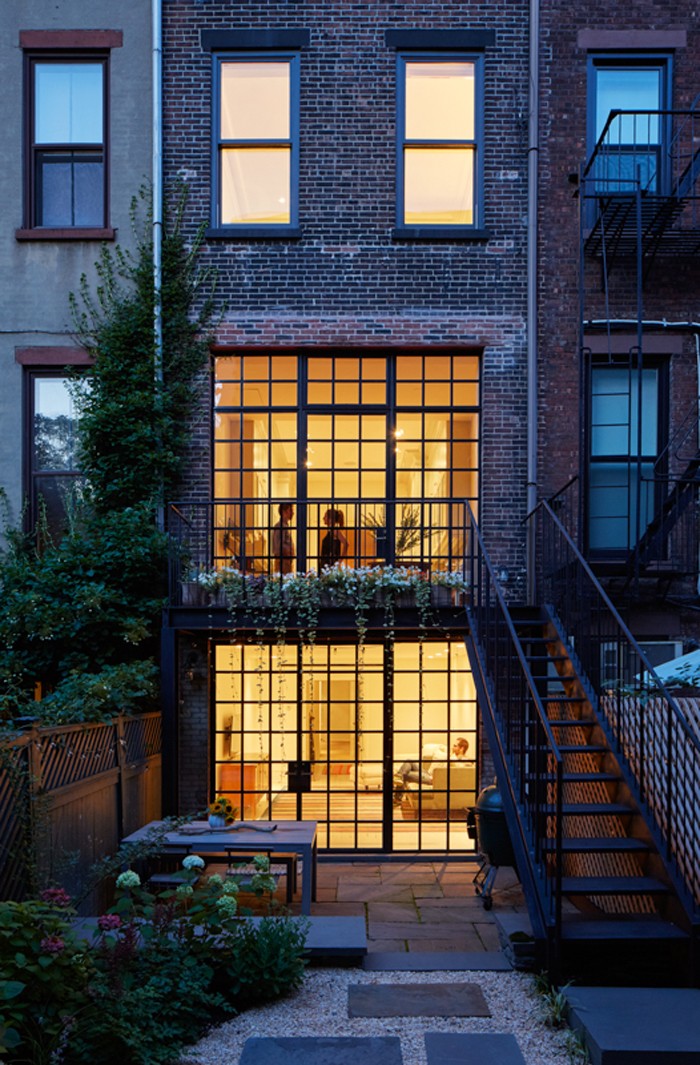
For a townhouse buyer, photos usually deserve a second pass for four specific reasons.
First, they can reveal sequence. If the front rooms are heavily detailed and the rear rooms are simpler, or if one floor is much more resolved than another, the buyer may be looking at a phased renovation or a partial one rather than a full-building overhaul.
Second, they can reveal what the house is being valued for. Some listings are clearly selling original detail. Others are selling a rear extension, a cook's kitchen, a landscaped garden, a rental unit, or the possibility of reconfiguration. That matters because the thing driving price is often also the thing that needs the most verification.
Third, they can reveal where the camera is working hard. Repeated wide-angle shots, cropped ceilings, no direct view of the stair, and carefully avoided service spaces usually mean the layout or condition is less straightforward than the prose suggests.
Fourth, they can reveal whether the house is relying on atmosphere instead of information. Beautiful styling is not the same thing as clarity.
How to read the floor plan like a building, not a brochure
The floor plan usually carries more truth than the photos, but only if the buyer reads it as a planning document rather than as a decorative diagram.
On a townhouse plan, the stair is one of the first things to look at. It tells the buyer how the house is organized vertically, whether the circulation is original or reworked, how much square footage is committed to movement rather than rooms, and how difficult major layout changes may become later.
Then look at the wet rooms. Kitchens and bathrooms are not just program. They are clues about plumbing stacks, venting paths, mechanical distribution, and whether the current arrangement is likely original, lightly updated, or fully reengineered.
Then look at depth. A surprisingly deep garden level or parlor floor can signal a rear extension. That may be excellent. It may also be the part of the house that carried the most structural, waterproofing, zoning, or landmark complexity.
What matters is not only the plan itself, but whether the plan and the listing language are leaning on a legal assumption.
DOB says a Certificate of Occupancy states the legal use and/or permitted occupancy of a building. New buildings must have one, and existing buildings need a current or amended CO when work changes use, egress, or occupancy type. DOB also says buildings built before 1938 may not have a CO, and may instead require a Letter of No Objection to confirm legal use if no CO exists. See Obtain a Certificate of Occupancy and Letter of No Objection or Completion.
That matters whenever a listing uses language such as "owner's duplex," "owner's triplex," "garden rental," "income-producing," "convertible two-family," or "single-family currently configured with rental flexibility." A floor plan can describe how a house is being used. It does not prove that use is legal.

The State disclosure form now reinforces the same point. It specifically asks whether there are certificates of occupancy related to the property, whether the property shares walls or easements with adjoining owners, and whether there are known defects in structural systems, the roof, plumbing, foundation, exterior walls, and floors. That is a useful buyer's checklist because it names the exact categories a listing tends to soften.
Broker language is not literal. It is directional.
Townhouse buyers waste time when they argue with listing language as if it were a technical report. The better question is what each phrase is trying to steer the buyer toward.
"Mint" often means visually complete, not systems-new.
"Architecturally renovated" may mean thoughtful design, but the useful next question is when the work was done, whether it included structure and full MEP replacement, and whether the filings were signed off.
"Owner's duplex" or "triplex" means nothing without legal-use confirmation.
"Income-producing" means the buyer should verify occupancy, meters, egress, and whether the economics being implied are actually durable.
"Expansion potential" or "room to grow" should immediately move the buyer toward zoning, landmarks, and rear-yard logic, not toward optimism.
"Needs updating" can mean cosmetic work, or it can mean the expensive parts of the building have simply not been shown yet.
"Move right in" can still coexist with a roof, facade, cellar, or systems problem that only matters once the buyer wants to hold the house for a decade rather than stage it for a season.
The point is not that broker language is deceptive by default. It is that the language usually compresses several different planning realities into one market-friendly phrase. Buyers should unpack the phrase before letting it into their budget model.
The records search belongs next to the listing, not after it
Townhouse buying in New York works better when the buyer reads the listing and the records at the same time.
DOB's Find Building Data page says buyers can use BIS and the DOB NOW Public Portal to review a building's history, including occupancy information, permits, complaints, inspections, and violations. That is the right place to start when a listing implies recent renovation, legal multi-unit use, or a major future alteration.
HPD says HPD Online can show complaints, violations, property registration, charges and litigation, block and lot information, and vacate orders. For buyers looking at multi-unit or mixed-use occupancy assumptions, that record matters as much as the listing's tone.
The Department of Finance says ACRIS lets users search property records and view document images for Manhattan, Queens, Bronx, and Brooklyn from 1966 to the present. For a townhouse buyer, ACRIS is part of how deeds, transfers, and recorded documents stop being abstract attorney territory and start becoming part of the due-diligence picture.
The Department of Finance also says property tax rates are based on tax class, and its current Class 1 guide defines Class 1 as one- to three-unit residential properties. The same guide explains that physical changes such as additions or renovations can affect assessed value outside the ordinary annual caps. See Property Tax Bills and the Class 1 Guide. If the listing is selling the house partly on low carrying cost, or if the buyer is comparing single-family and multi-unit scenarios, that context belongs in the file early.
If the listing leans on future possibility, zoning belongs in the same early pass. The Department of City Planning's ZoLa user guide says ZoLa allows searches by address, borough-block-lot, and intersection, and returns zoning information, additional zoning information, and building and property information for the searched location. See the ZoLa User Guide.
And if the buyer is underwriting a garden-level build-out, lower level bedroom, or insurance-sensitive purchase, the current State disclosure form is a reminder not to skip flood questions. The form now asks whether the property is in a FEMA-designated floodplain, a Special Flood Hazard Area, or a moderate-risk flood hazard area, whether flood insurance is required, whether there is flood insurance on the property, whether prior flood assistance was received, and whether the structure has experienced water penetration due to seepage or a flood event.
A better way to read a listing before the tour
The buyer does not need a perfect answer before stepping into the house. The buyer needs a sharper question set.
Before the showing, the listing should have been read for:
- what part of the house is carrying the value story
- which floors and service spaces are missing from the image set
- whether the floor plan implies extension, reconfiguration, or multi-unit use
- whether the description is making legal, financial, or scope assumptions
- which records need to be checked before the buyer gets emotionally attached
After the showing, those questions usually get narrower, not broader.
If the house still feels strong, that is when this guide should hand off to the Townhouse Buyer's Inspection Guide: What a Standard Inspection Misses. The listing phase is about decoding the sales story. The inspection phase is about pressure-testing the building that story sits on.
The practical next step
Do not ask whether a listing is good. Ask what it is leaving you to prove.
For a townhouse, the useful reading is never just visual. It is the overlap between atmosphere, plan logic, legal use, building history, and the parts of the house that are expensive precisely because no one advertises them clearly.
That is the shift from browsing to buying. The listing is not there to tell the buyer everything. It is there to tell the buyer where to look harder.
If you want help pressure-testing a townhouse before the purchase decision hardens, start with the Work With Me page.
Official references worth reviewing
- New York Department of State: Property Condition Disclosure Statement
- New York Department of State: Additional Forms - Real Estate Salesperson
- NYC DOB: Obtain a Certificate of Occupancy
- NYC DOB: Letter of No Objection or Completion
- NYC DOB: Find Building Data
- NYC HPD: HPD Online
- NYC Department of Finance: ACRIS
- NYC Department of Finance: Property Tax Bills
- NYC Department of Finance: Class 1 Guide
- NYC Department of City Planning: ZoLa User Guide